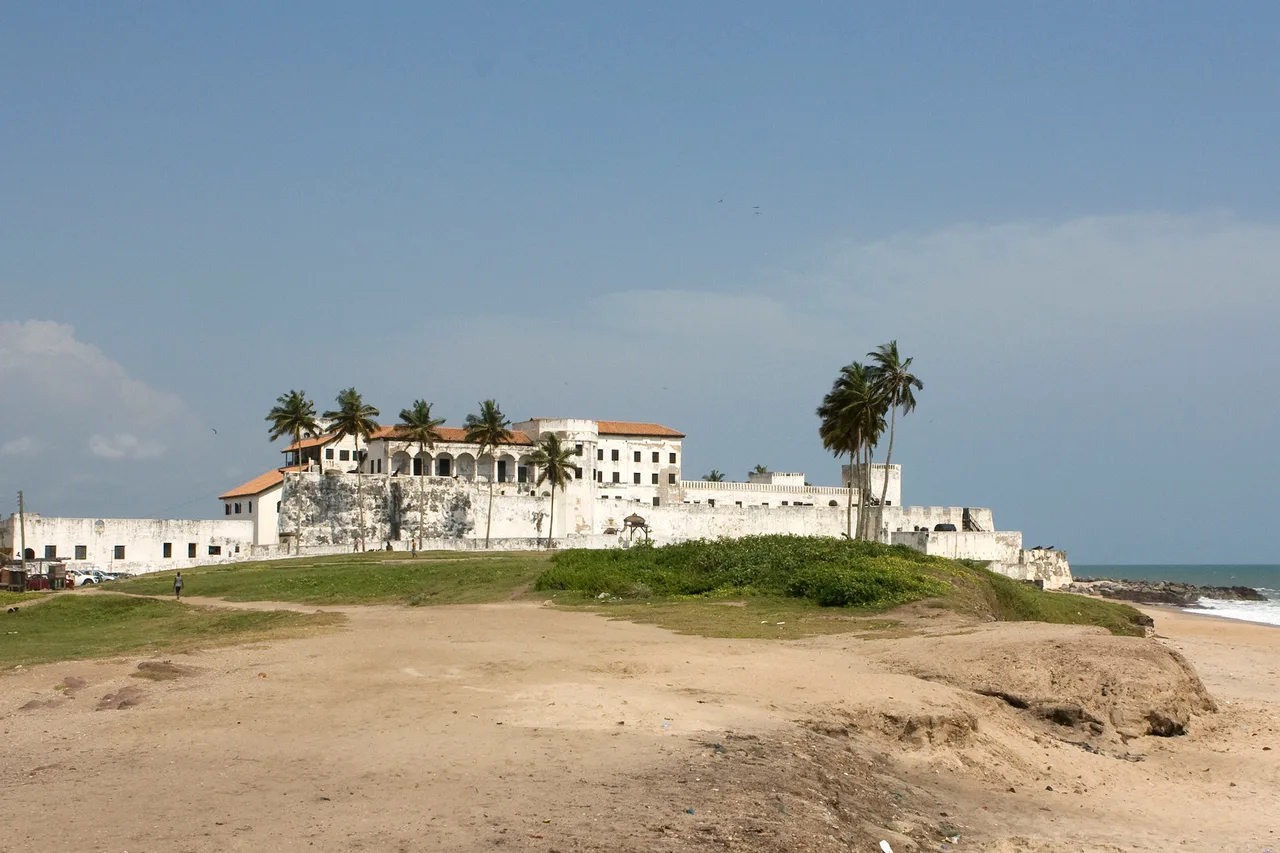
Why there are so many forts on one coast
Ghana's coastline has around thirty surviving forts and castles, one of the densest concentrations anywhere in the world. They were not built to hold enslaved people. They were built for trade, and the trade was gold and ivory long before it was human beings.
The Portuguese arrived at the end of the fifteenth century and built Elmina Castle in 1482, making it one of the oldest European buildings in sub-Saharan Africa. The Dutch, English, Danes, Swedes and Brandenburgers followed, each taking or building their own fort, because whoever held the coast held the trade inland. Merchants from the interior brought gold south to these gates, and European goods went north.
- Elmina Castle: built by the Portuguese in 1482, taken by the Dutch in 1637, sold to the British in 1872.
- Cape Coast Castle: began as a Swedish fort in the 1650s, became the British headquarters on the coast.
- Osu Castle, or Christiansborg: Danish, and later the seat of Ghanaian government.
When the trade turned
As the Atlantic demand for enslaved labour grew through the seventeenth and eighteenth centuries, the forts were adapted. Dungeons were built or expanded beneath the trading halls, and the castles became holding points. Captives were brought from the interior, held in these rooms, and loaded onto ships for the crossing.
The scale is hard to hold in your head and it is not useful to try. What is worth holding onto is that this was an organised commercial system with shareholders, insurance and ledgers, and that African states and merchants were participants and not only victims. The trade was ended by Britain in 1807 and slavery in British colonies in 1833, though illegal trafficking continued for decades afterwards and slavery itself persisted in various forms.
What you see inside
The tours at Cape Coast and Elmina are guided and you cannot walk them unaccompanied. At Cape Coast you see the male and female dungeons, the Door of No Return that opens onto the beach where ships were loaded, and above it, directly above it, the governors' quarters and a chapel. That arrangement is the thing most visitors remember, because the guide will point it out and let it sit.
At Elmina the layout is different and the castle is older, with a courtyard, a church and the female dungeon that opens onto the courtyard where the governor could look down. Fort St Jago sits on the hill above the town with the best view of both the castle and the fishing harbour. Both castles have a museum, both are UNESCO World Heritage sites, and both are still used for ceremonies.
- Allow two to three hours at each castle including the tour.
- The first tour of the morning is smaller, cooler and gives you more time with the guide.
Doing the visit properly
These are places where people died, and they are now visited by large numbers of people in holiday mode. The guides handle this better than most visitors do. Follow their lead: keep your voice down, do not take photographs where you are asked not to, and do not treat the dungeons as a backdrop.
Go early. The tours fill from mid-morning in December, and the last tour of the day is rushed. Do Cape Coast and Elmina on separate days rather than one after the other, because the emotional weight of the second will be lost if you have not had time to sit with the first. And leave time afterwards for the towns, which are working places rather than museum pieces.
- Do not schedule anything demanding for the rest of the day after a castle tour.
- Take the guide's account seriously. They live here and they tell it every day.
The other sites on the same map
Cape Coast and Elmina are the famous ones, but they are part of a system that runs along the whole coast. Fort Amsterdam at Abandze and Fort William at Anomabo are half-forgotten and often empty, and seeing them with no other visitors shows how many of these structures there are. Further west, Fort Metal Cross at Dixcove and Fort Batenstein at Butre sit above fishing harbours. They are free of interpretation boards and largely free of visitors.
Inland, the Assin Manso Slave River site marks where captives were bathed and rested before the final march to the coast. It is quiet and unpolished. Salaga, in the north, was one of the largest slave markets in West Africa and belongs to the trans-Saharan trade rather than the Atlantic one, which is a reminder that this history did not run in only one direction.
What the country does with it now
Ghana has built a public memory around these sites that is unusual in the region. The Year of Return in 2019, marking four hundred years since the first recorded enslaved Africans landed in Virginia, made the castles the centre of a national homecoming programme, and the Beyond the Return campaign continued it.
That has been economically significant and it has drawn criticism, including from Ghanaians who point out that the country's own descendants of enslaved people do not always share in the benefits, and from writers who worry that commemoration can shade into commodification. Both things are true at once. Go, and go with that in mind, and the visit will be worth more than a photograph at the door.