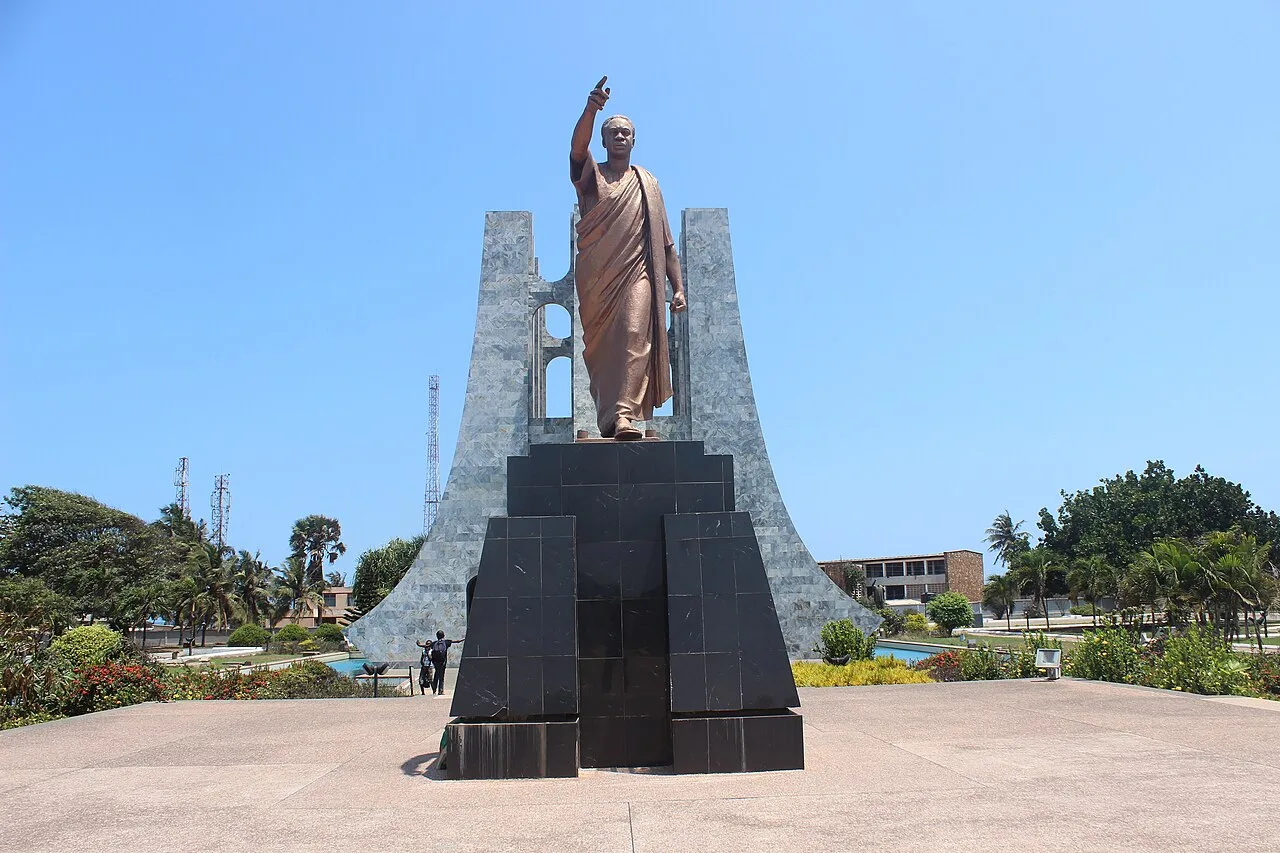
The colony that became a country
The British called it the Gold Coast, and by the 1940s it had a substantial educated elite, a functioning legislative council and a generation that had been through the Second World War and was not inclined to wait. The United Gold Coast Convention was formed in 1947 to push for self-government, and it hired Kwame Nkrumah as its general secretary.
Nkrumah had been studying and organising abroad for over a decade. He broke with the UGCC in 1949 and founded the Convention People's Party, which aimed at immediate self-government rather than a gradual transfer. He was jailed in 1950 for leading a campaign of positive action, and the CPP won the 1951 election while he was still in prison.
6 March 1957
Ghana became independent on 6 March 1957, the first country in sub-Saharan Africa to win independence from colonial rule. Nkrumah became Prime Minister. At the celebrations in Accra he said that Ghana's independence was meaningless unless it was linked to the total liberation of the African continent, which was not rhetoric so much as a statement of programme.
The new country took a new name and a new flag, with the Black Star borrowed from the shipping line Marcus Garvey had founded for the back-to-Africa movement. In 1960 Ghana became a republic and Nkrumah became President.
- Independence: 6 March 1957.
- Republic declared: 1 July 1960.
What Nkrumah built
The early years were a serious programme of construction. The Volta River Project and the Akosombo Dam were the largest, giving the country hydroelectric power and an aluminium industry. The Tema motorway and harbour were built. So were hospitals, schools, the University of Ghana's expansion, and the Black Star Square and Independence Arch that still frame the national celebration.
He was also a central figure in Pan-Africanism. Ghana under Nkrumah hosted liberation movements from across the continent, organised the All-African People's Conference in 1958, and pushed hard for African unity. The Organisation of African Unity was founded in Addis Ababa in 1963, and Nkrumah wanted it to go much further than it did toward a single continental government.
Where it went wrong
Nkrumah's government became increasingly authoritarian. Preventive detention was used against opponents, the courts were constrained, and a one-party state was formalised. Ghana's economy, dependent on cocoa prices, deteriorated through the early 1960s, and austerity measures were unpopular. He survived several assassination attempts.
On 24 February 1966, while he was on a state visit to Hanoi, his government was overthrown in a military coup. Nkrumah went into exile in Guinea, where Sekou Toure made him a co-president. He died in Bucharest in 1972. His body was returned to Ghana, and the mausoleum in Accra is now one of the most visited sites in the country.
The decades after
Ghana spent the next fifteen years alternating between civilian and military rule, with coups in 1966, 1972, 1978 and 1979. In 1979 Jerry John Rawlings took power, handed over to an elected government, and then took power again in 1981. He ruled until 1992, when a new constitution and multiparty elections returned the country to civilian rule.
Since 1993 Ghana has held a series of competitive elections and has seen power change hands between parties more than once without violence, which in the region is a real achievement rather than a small one. The political memory of Nkrumah is contested and mostly positive on the street: his birthday is commemorated as Founder's Day, and his face is on the currency.
Where to see it in Accra
Kwame Nkrumah Memorial Park holds the mausoleum, the museum and the park itself, and it is a straightforward half day. Independence Square and Black Star Gate next to it are where the celebration happens every 6 March, and the architecture is worth an hour on its own. The National Museum of Ghana, a short distance away, covers the whole sweep from prehistory to independence and is better than its reputation suggests.
Jamestown, just west, is a good counterweight. It is the oldest part of the city, with the lighthouse and the fishing harbour, and it is where the colonial and the Ghanaian city sit visibly on top of one another.